Why things your parents said never leave you
You forget most of last Tuesday, but one sentence from a parent can stay for decades. Here is what the research says about why, where the evidence is thin, and three ways to loosen its grip.
 By The Better Mode TeamPublished Nov 23, 202611 min read
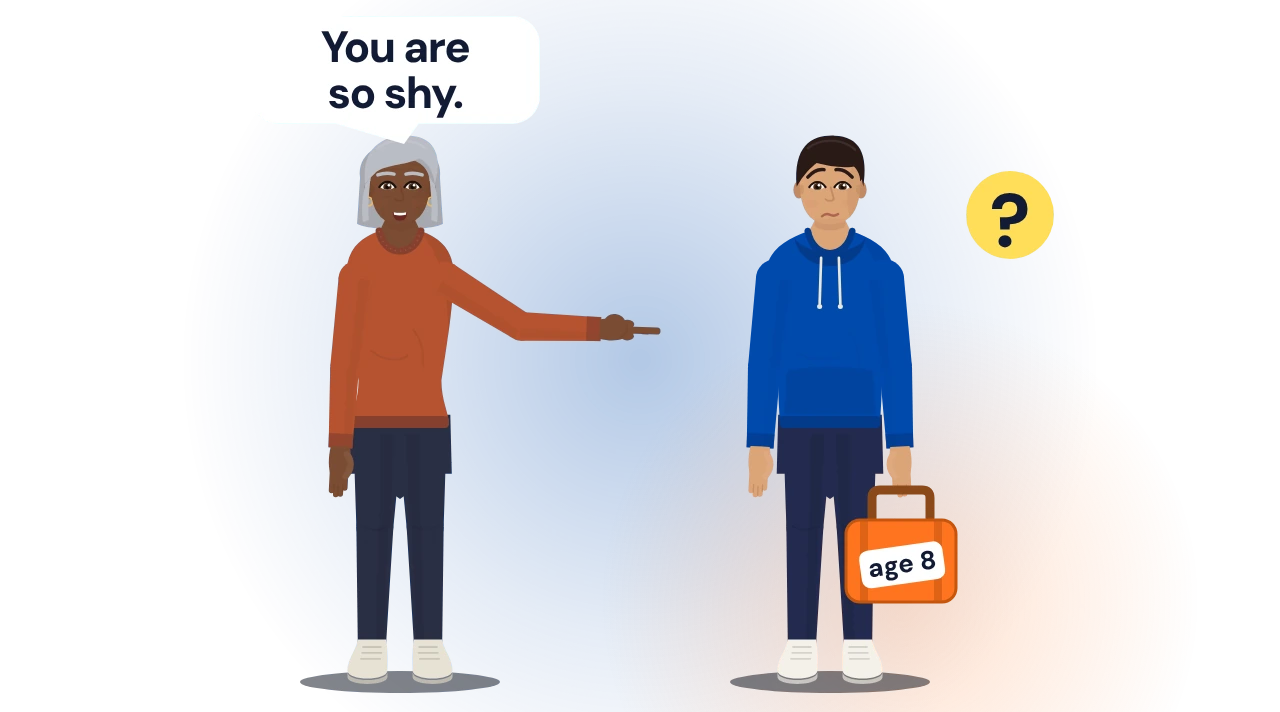
The short answer
Moments with strong emotion are stored more firmly than ordinary ones, and a sentence from a parent often arrives with plenty of emotion. Bad experiences also tend to leave a bigger mark than good ones, which is why one careless line can outlast ten kind ones.
The parent often forgets because, from their side, it was one tired sentence among thousands. Researchers have linked harsh remembered parenting to a harsher inner voice in adults, but that work relies on memory and cannot show cause.
You cannot erase the sentence. You can notice it, ask whose it is, and answer it the way you would answer a friend. Three habits are near the end.
Watch the video
Prefer to watch first? The full video runs about six and a half minutes. The article goes further into the research and says where it is thin.
Chapters
Key takeaways
- Emotion tells the brain a moment matters, so a sentence said in a heated or vulnerable moment can outlast thousands of ordinary days.
- Negative moments weigh more than positive ones across many areas of psychology, which helps explain why criticism sticks better than praise.
- Remembered parenting and self-criticism are linked, but the link rests on recall and does not prove cause.
- Even praise can backfire, but that finding is disputed: a large replication found much weaker effects.
Why your brain stamps some moments
Memory is not a recording. The brain keeps what it treats as important, and emotion is one of its strongest signals. Across decades of work, James McGaugh and colleagues showed that emotionally arousing experiences set off stress hormones and activity in the amygdala, and that this helps the brain consolidate the memory (McGaugh’s 2004 review).
Now think about what that means for a child. The tone of voice, the room, where everyone stood: if the moment felt big, the brain may file the whole scene, and the sentence travels with it. A calm Tuesday dinner gets no stamp, so it fades.
The review draws mostly on animal studies and human brain imaging. It explains why emotional moments are remembered better in general. It does not tell us which parent sentences get stamped, or how often.
Why a parent’s opinion sounds like a fact to a child
A young child has very little to compare a parent against. Parents explain the sky, the rules and the weather, so when one of them says “you are so shy,” it can land as information about who you are, not as an opinion about one afternoon.
No study in this article measures that exact step, so read it as a reasonable account of how children learn, not a measured result. The practical point still holds: a label from a trusted adult is easy to carry, because the child had no reason to question it.
Why the parent often forgot
Many parents have no memory of the line at all. This is where the two sides differ most. For you it was a sentence at the center of a scene. For them it was one of thousands of things said while driving, cooking or running late.
That mismatch is why the adult conversation so often starts with “I never said that.” Both people can be telling the truth. One stamped the moment and the other did not. It does not apply to every parent: some remember, and some meant it.
The negativity bias
Roy Baumeister and colleagues reviewed research across many areas and concluded that bad events, bad feedback and bad parenting leave a bigger mark than good ones (2001 review). They describe it as a general principle, not an iron law.
Bad is stronger than good.
The title of Baumeister and colleagues’ 2001 reviewPaul Rozin and Edward Royzman described the same tilt in four forms, including a tendency for negative events to dominate when they are mixed with positive ones (2001 paper).
In practice that looks like ten kind comments and one careless one, and the careless one is the one you replay. It is not fragility. The brain is built to hold on to warning signs.
When the sentence is a compliment
Sometimes the sentence that stays was meant kindly. “You are the smart one” or “you are so responsible” can harden into a label, and labels come with pressure to keep being it.
In a classic set of experiments, Claudia Mueller and Carol Dweck praised fifth graders either for being smart or for working hard. The children praised for ability later chose easier tasks, enjoyed them less after failing and performed worse than the effort group (1998 paper).
Eddie Brummelman and colleagues found a related pattern with over-the-top praise. Adults gave more inflated praise to children with low self-esteem, and in an experiment with 240 children, inflated praise made those children less likely to pick a challenge (2014 paper).
Now the caution. In 2019, Yue Li and Timothy Bates ran a close replication of the Mueller and Dweck work with 624 children. Most of the original effects did not appear, and one measure of performance after failure showed a small effect (2019 replication).
A large meta-analysis of growth mindset research, a related but different idea, also found weak overall effects on school grades (Sisk and colleagues, 2018).
The fair reading is this: the idea that labels can box a child in is plausible and worth noticing, but it is not a rule, and the research is argued over. Praise is not the enemy. Specific, true feedback about effort is simply easier to live with than a permanent title.
| Study | Who | What it found | Caveat |
|---|---|---|---|
| Mueller and Dweck, 1998 | Fifth graders, six studies | Praise for being smart led to safer choices and weaker recovery from failure | Lab tasks, praise from a stranger |
| Brummelman and colleagues, 2014 | Parents and 240 children | Inflated praise reduced challenge seeking in children with low self-esteem | One short task, one culture |
| Li and Bates, 2019 | 624 children in China | Most original effects did not appear | Original authors dispute the standard used |
| Sisk and colleagues, 2018 | Two meta-analyses, up to 365,915 students | Weak overall effects of mindset on school results | About grades, not parenting |
Praise and mindset research at a glance. Gold: original finding. Orange: later work with weaker or limited results.
Sentences meant to protect you
Not every sentence is a criticism. “Be careful,” “what will people think” and “do not make a fuss” often come from a parent who was worried. Intent and effect can differ, though. A protective line can still turn into an inner rule, such as asking what people will think before every decision.
This part is observation, not research. It is worth checking only because the sentence you remember may not sound harsh at all.
When it becomes your own voice
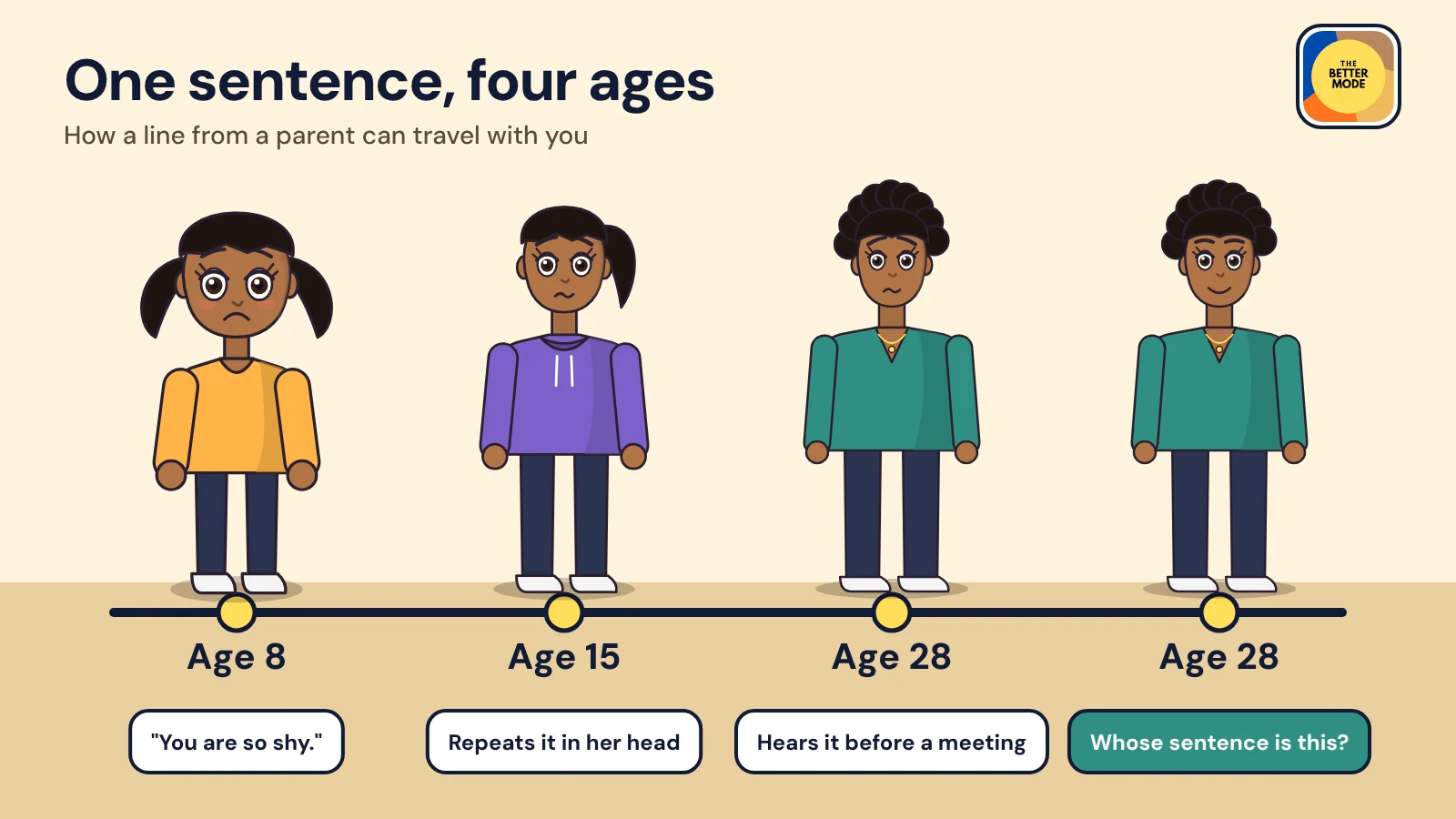
Over time the sentence can move from a voice outside you to one inside. You stop hearing your parent’s tone and start hearing your own opinion about yourself: typical, do not be dramatic, not good enough.
In 2006, Chris Irons, Paul Gilbert and colleagues asked 197 undergraduates to describe how they remembered their parents. Students who recalled their parents as rejecting or overprotective tended to score higher on harsh self-criticism (Irons and colleagues, 2006).
Read that carefully. It is a link, not proof. Everyone was reporting from memory, memory shifts with mood, and a self-critical person may simply recall the past more harshly. The study cannot say which came first.
Being fair to parents
It helps to be fair. Most parents were tired, stressed and doing their best with what they had. Many of the sentences they said probably came from their own parents, passed along without a second thought.
Fairness does not mean pretending it did not hurt. You can hold both: the sentence was careless, and the person who said it was human. You do not need a war with a parent to stop carrying the sentence.
What the research supports
- Emotional moments are remembered more firmly.
- Negative experiences weigh more than positive ones.
- Remembered parenting links to self-criticism.
- Stepping back from your own problem improves reasoning.
What it does not show
- That one sentence causes a lasting problem.
- That praise always backfires.
- That a parent meant harm.
- That the effects are the same for everyone.
How strong is the evidence, honestly
Because this topic touches family, it is easy to overstate. The figure below shows how directly each source supports the claim we use it for. Reviews sit at the top. Memory-based and disputed work sits at the bottom, and the text says so.
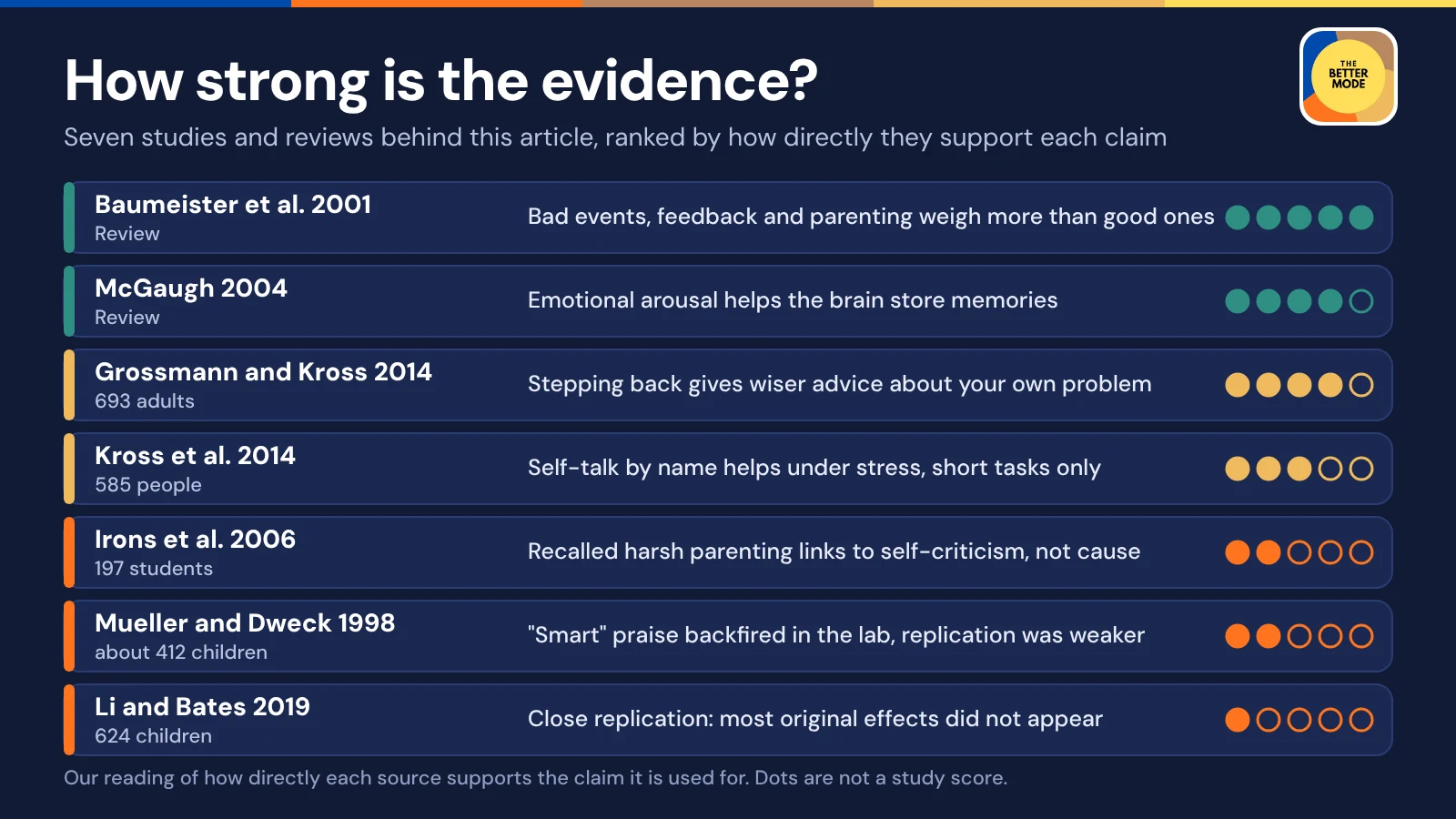
Notice what is missing: a study that follows children for decades and shows one sentence changing an adult life. That evidence does not exist for this question. What we have are reviews of emotional memory, work on how bad experiences weigh more, links based on recall, and short experiments on coping skills.
Three things you can try
These steps come from the self-distancing and self-talk research. They are skills to practice, not a cure, and the studies tested stress and advice tasks, not childhood sentences.
Ask whose sentence it is
When a harsh thought shows up, catch it and ask: whose sentence is this? Often you can hear the rhythm of a phrase a parent always used. Naming the source separates a line you inherited from a fact about you.
Would I say this to a kid I love?
Igor Grossmann and Ethan Kross found that people reason more wisely about another person’s problem than their own, and that stepping back from your own situation closes that gap (Grossmann and Kross, 2014). Picture a child you love hearing your inner sentence. If you would not say it to them, you do not have to say it to yourself.
Update it to something honest
Kross and colleagues found that using your own name or “you” instead of “I” when you talk to yourself helped people stay calmer under social stress (Kross and colleagues, 2014). Keep the update small and believable.
Joanne Wood and colleagues found that people with low self-esteem felt worse after repeating a big positive statement like “I am a lovable person” (Wood and colleagues, 2009). “I am amazing” can backfire. “I can ask for help, and most people are glad when I do” is easier to believe.
There is one more step, and it is not about you. You will say sentences to someone too: a child, a friend, a coworker. They might not remember last Tuesday. They might remember that one.
A note on mental health
This article is for education, not therapy. If a sentence from your childhood still hurts a lot, or you are struggling with how you talk to yourself, a licensed therapist can help.
Frequently asked questions
Why do I remember one sentence from my parents but not what I ate yesterday?
The brain tends to keep moments that carry strong emotion. Research on emotional memory suggests stress hormones and the amygdala help consolidate those moments, while ordinary days fade. A parent’s sentence said in a tense or tender moment can get that stamp.
Does one harsh sentence from a parent cause an inner critic?
No research shows that. Studies link remembered rejecting or overprotective parenting with harsher self-criticism in adults, but they rely on memory and cannot show cause. Many things shape how you talk to yourself.
Is praise bad for children?
No. Some experiments found that praising ability, or praising in an over-the-top way, backfired for certain children. A 2019 replication with 624 children found much weaker effects. Specific, honest feedback about effort and what the child actually did is a safer default.
Why do parents forget what they said?
Often because it was one sentence among thousands, said while tired or busy. The listener stamped it with emotion and the speaker did not. Both people can be telling the truth when one says “I never said that.”
Can a compliment be as heavy as an insult?
It can. A label such as “the smart one” or “the responsible one” can come with pressure to keep living up to it. The research on this is disputed, so treat it as something worth noticing, not a rule.
Should I confront my parent about the sentence?
You do not have to. Many people get most of the relief from noticing the sentence and answering it themselves. If you do want to talk to your parent, a calm, specific conversation tends to go better than an argument about who remembers it correctly.
When should I talk to a therapist?
If the sentence still hurts a lot, shapes big decisions, or comes with low mood or anxiety that does not ease, a licensed therapist can help. This article is general information, not treatment.
References
- Baumeister, R. F., Bratslavsky, E., Finkenauer, C., & Vohs, K. D. (2001). Bad is stronger than good. Review of General Psychology, 5(4), 323-370. DOI
- Brummelman, E., Thomaes, S., Orobio de Castro, B., Overbeek, G., & Bushman, B. J. (2014). “That’s not just beautiful, that’s incredibly beautiful!”: The adverse impact of inflated praise on children with low self-esteem. Psychological Science, 25(3), 728-735. DOI
- Grossmann, I., & Kross, E. (2014). Exploring Solomon’s paradox: Self-distancing eliminates the self-other asymmetry in wise reasoning about close relationships in younger and older adults. Psychological Science, 25(8), 1571-1580. DOI
- Irons, C., Gilbert, P., Baldwin, M. W., Baccus, J. R., & Palmer, M. (2006). Parental recall, attachment relating and self-attacking/self-reassurance: Their relationship with depression. British Journal of Clinical Psychology, 45(3), 297-308. DOI
- Kross, E., Bruehlman-Senecal, E., Park, J., Burson, A., Dougherty, A., Shablack, H., Bremner, R., Moser, J., & Ayduk, O. (2014). Self-talk as a regulatory mechanism: How you do it matters. Journal of Personality and Social Psychology, 106(2), 304-324. DOI
- Li, Y., & Bates, T. C. (2019). You can’t change your basic ability, but you work at things, and that’s how we get hard things done. Journal of Experimental Psychology: General, 148(9), 1640-1655. DOI
- McGaugh, J. L. (2004). The amygdala modulates the consolidation of memories of emotionally arousing experiences. Annual Review of Neuroscience, 27, 1-28. DOI
- Mueller, C. M., & Dweck, C. S. (1998). Praise for intelligence can undermine children’s motivation and performance. Journal of Personality and Social Psychology, 75(1), 33-52. DOI
- Rozin, P., & Royzman, E. B. (2001). Negativity bias, negativity dominance, and contagion. Personality and Social Psychology Review, 5(4), 296-320. DOI
- Sisk, V. F., Burgoyne, A. P., Sun, J., Butler, J. L., & Macnamara, B. N. (2018). To what extent and under which circumstances are growth mind-sets important to academic achievement? Two meta-analyses. Psychological Science, 29(4), 549-571. DOI
- Wood, J. V., Perunovic, W. Q. E., & Lee, J. W. (2009). Positive self-statements: Power for some, peril for others. Psychological Science, 20(7), 860-866. DOI
Written by The Better Mode Team
We turn psychology research into short, clear videos and articles. Claims are checked against the original studies, and we say so when the evidence is early. This content is educational and not a substitute for professional care.
More from Relationships
Short, clear reads on the people who shape how we think and feel.
Browse RelationshipsMake every day a little better
One short idea each week from The Better Mode. Free, and you can leave any time.